Monday, May 13, 2013

Your Smiling Face by James Taylor: A Refreshing, Simple Song Structure


A really lovely song; short and sweet with a simple structure; but dense with chords and lyrics.  Not an easy song to write I would imagine, but totally do-able and refreshingly different from standard formulas.

Here's the most basic overview of the structure:

-V1
(key change)
-V2
(two quick key changes)
-Breakdown
-Refrain to fade out

So let's call that three formal sections with the first two (V1 and V2) being, musically, a repeat only with different lyrics, and the last section starting with the breakdown but evolving into a continually building repetition of a 4 bar phrase extracted from earlier in the song.

Here's the first verse broken into two sections:

V1
section a
     "Whenever I see your smiling face, I have to smile myself 
     Because I love you, yes, I do. (here's where that awesome guitar riff happens)
     And when you give me that pretty little pout, It turns me inside out.
     There's something about you, baby, (again that guitar riff happens here)
     I don't know.

section b
     Isn't it amazing a man like me     (melody goes higher here, kinda like most pre-
     Can feel this way,                     choruses in most songs, but is this a chorus?)
     Tell me how much longer, 
     It could grow stronger every day. 
     Oh, how much longer?"      (here, there's a smooth transition back into the intro riff that
                                             hurls us forward into a key change and the second verse)

So, the next thing we hear is V2, but usually there is a chorus before V2.  Where is the chorus?  I don't hear a traditional chorus with the song title and main message of the song, do you?  So, look back at V1 and find the spots you find most memorable.  For me, it's the second and fourth line of the first section of the verse (the guitar riff I keep pointing out. Notice that it's also a change of feel).

V2
section a
     "I thought I was in love a couple of times before with the girl next door,
     But that was long before I met you, (guitar riff)
     Now I'm sure that I won't forget you.
     And, I thank my lucky stars that you are who you are,        
     And not just another lovely lady (guitar riff)
     Set out to break my heart.

section b
     Isn't it amazing a man like me (varies the melody slightly here)
     Can feel this way,
     Tell me how much longer, 
     It could grow stronger every day."

Ok, so, section b is exactly the same in V1 and in V2, but for me, it's still not a proper chorus.  It's memorable and we here it at the end of each verse, but we don't hear it again after the upcoming breakdown.  To me, it's just the end or second half of the verse.  The song up to this point is strophic; a lot like "Sound of Silence" by Simon and Garfunkel (see past post for insights from that song).  Each verse has a strong, arched structure with the high note in the middle and memorable melodies and chord progressions throughout, but that's it.  That isn't to say it's easy to do; it's actually extremely difficult.  Sometimes a cool, big, or dramatic chorus can be a crutch for a boring verse.  In this song, every line is memorable and cohesive with the line before and after it.

…again with the intro riff, two key changes this time, and we come into the...
Breakdown and Refrain

-The chords are from earlier (this is key for keeping the song cohesive)
-The melody is very similar to a couple parts of the verse but not exactly the same
-The lyrics are new but they also contain the title of the song in some form or variation (in bold below).

     "No one can tell me that I'm doing wrong today, whenever I see you smile at me.
     No one can tell me that I'm doing wrong today (my favorite guitar riff back in)
     Whenever I see your smiling face my way.
     No one can tell me that I'm doing it wrong today.
     No one can tell me that I'm doing it wrong today."

That continues until the fade out.  Once again, look at the basic structure:

-V1
(key change)
-V2
(two quick key changes)
-Breakdown
-Refrain to fade out

The secret is making each verse memorable the whole way through (strong, arched structure with the high note in the middle and memorable melodies and chord progressions throughout).

What are the most hook-like or memorable parts of the verse TO YOU?  The answer to that question will help you write your own songs that you will be proud of and that will sound unique to your own voice and style.

Happy songwriting!

-Jonathan

Sunday, April 28, 2013

Green Garden by Laura Mvula


Let's take a look at these lyrics line by line.

Take me outside, sit in the green garden 
Beseeching someone.  We get a mental image immediately of a lush place where she is with another person.
Nobody out there, but it's okay now, 
There's no one there now, but maybe there used to be.  Also she's ok with there not being anybody there now, but maybe she had to get over her feeling for someone who used to be there.
bathe in the sunlight, don't mind if rain falls,
taking it in, showing us the environment, giving us an idea about her feelings toward the world; she doesn't care if the rain falls. 
take me outside, sit in the green garden, 
Apparently we've heard all we need to hear about the green garden for now.  She simply repeats and reinforces the initial plea to the unknown listener whom we all assume is an ex-lover.
ooh ah, ooh ah oh, 
ooh ah, ooh ah oh

And I'll fly on the wings of a butterfly 
Keeping with the garden environment for this second verse, she is identifying with nature, beautiful things that reside in the garden.
high as a tree top and down again
up and down, has metaphorical implications about moods.
putting my bag down, taking my shoes off 
another mental image of her in the garden, all we know is that she is there, she came from somewhere else, but here, she is relaxed, shoeless, connecting with and reveling in natural beauty.
walk in the carpet of green velvet

Dance in my garden like we used to, 
Finally, we get a strong suggestion that she is longing.  Longing for an experience she used to have with the ex-lover.  This line is given importance and emotional charge by being separated and divided by "ooohhs" etc.
ooh ah, ooh ah oh
Dance in my garden like we used to, 
ooh ah, ooh ah oh

Take me outside, sit in the green garden 
nobody out there, but it's okay now, 
bathe in the sunlight, don't mind if rain falls, 
take me outside in the green garden
At this point we are reveling in the song.  We hear the first verse with some new chords and other musical elements, but still just rehearing her initial plea and description of this green garden

I'll go, wherever you go, wherever you take me, I'll go 
Here's something new right after we have a repeat of the first verse.  We are well established in the idea, lyrics, and vibe of the song.  It's the appropriate place for a "C" section or bridge.  The lyric idea is compelling, but basically generic.  It could fit into any song.  There are a lot of logical weaknesses with this line; we had no idea we were following anyone all over the place literally or metaphorically (in fact we were asking someone to take us into a garden), the only place she has gone within the garden is up the tree and back down again, she wanted to dance in her garden not leave it.  It's basically just saying,"I like you a lot, and would do anything to be with you."  But, that sentiment is not really part of the heart of the rest of the song, which by all evidence is a reminiscence of love gone by.

Take me outside, sit in the green garden. 
Take me outside, sit in the green garden.

And I'll fly on the wings of a butterfly 
highs of tree top and down again 
putting my bag down, taking my shoes off 
walk in the carpet of green velvet 

Dance in my garden like we used to, 
the dance. 
Dance in my garden like we used to.. 

Take me outside, take me outside, 
take me outside, sit in the green garden. 

I'll go, wherever you go, wherever you take me, I'll go 
I'll go, wherever you go, wherever you take me, I'll go.

Wednesday, May 11, 2011

Interview with Ralph Murphy

I strongly recommend watching this entire interview. I learned a lot from it, and I'm definitely going to buy his book.


Tuesday, May 3, 2011

Duet Series: "Young Folks" by Peter, Bjorn, and John


Structure

Well, here is a simple song.

Verse
Chorus
Verse
Chorus

Really? You might say. Are there only 2 musical sections that are simply repeated twice? Well, basically, yes!

Let's look a little closer though:

Verse 1 has two formal sections within it that are sung twice with different lyrics. The first one is sung by Him, the second is sung by Her.

1.1 Sung by Him:
"If I told you things I did before, told you how I used to be,
Would you go along with someone like me?
If you knew my story word for word, had all of my history
would you go along with someone like me?"

1.2 Sung by Her:
"I did before and had my share, it didn't lead nowhere
I would go along with someone like you
It doesn't matter where you've been, who you were hanging with
We can stick around and see this night through"

Chorus sung by Both:
"And we don't care about the young folks
talking 'bout the young style
And we don't care about the old folks
talking 'bout the old style too

And we don't care about our own faults
talking 'bout our own style
All we care about is talking
talking only me and you"

Verse 2 goes like this
Verse 2.1 sung by Her
"Usually when things have gone this far people tend to disappear
No one will surprise me unless you do"
Sung by Him:
"I can tell there's something going on, hours seem to disappear
Everyone is leaving, I'm still with you"
Verse 2.2 sung by Both
"It doesn't matter what we do, where we are going to
We can stick around and see this night through"

But, alas! What an anomaly! The second half of the second verse is cut short. They only sing those two lines in unison and then go straight on into the second chorus instead of singing the two more lines that would make the second verse of equal length with the first verse. But hey, why not? There's no reason to keep singing words just for the sake of structural evenness. In fact, as we've seen with other songs, the second verse is often not only shortened but cut in half.

The second chorus goes on ad infinitum from here to the end of the recording.

Lyrics

What are they saying?

-Verse 1.1
The first half of the first verse, sung by Him, communicates a very simple sentiment: if you knew the real me, would you still like me? It's not only a simple sentiment, it's an extremely vulnerable one and therefore draws the listener in immediately. He asks that question twice with different words, and that makes up the whole first half of verse 1. The first four lines are the same question asked twice in different words. This allows the listener to meditate. It takes time to focus on one issue before moving ahead in the story/conversation. And, taking the time to meditate on this particular issue, the simple and vulnerable one, is probably a very important reason for why this song exhibits such emotional immediacy.

-Verse 1.2
The first line of the girl's response doesn't make a lot of sense to me. The lyrics are a bit obscure until she sings "I would go along with someone like you," which is, obviously, a direct answer to that vulnerable question posed by Him in the first four lines. Her next two lines are a continued and MORE DETAILED response to his question. That, to me, is the key to going deep into one issue and keeping a song focused–one must find the interesting facets, the deeper details, the other words for one issue. The Guy asks the same question twice with different words, the Girl responds to that question with details, thoughts of her own. A lot of time and words are devoted to one question and one answer.

-Chorus
The chorus is sort of it's own thing as far as the lyrical concept goes. It doesn't directly relate to that question and answer in the first verse. What it does do is it focuses on the idea of nothing being important outside of their relationship. Question: Do they ever say "nothing is important outside of our relationship"? Heck no!!!! That would be really really boring. Instead, they find another way to say it. They use words that convey that idea in terms of its interesting facets, deeper details, or other words. It's not direct. It's resourceful. It relates the central idea, nothing is important outside our relationship, to other ideas. "We DON'T care about the young folks..." "we DON'T care about the old folks." "All we care about is talking, talking only me and you."

-Verse 2.1
The story moves forward here. After the inner thoughts of insecurity are voiced in verse 1, we see these two people actually start to come together. They show us the situation of how they talk with each other for longer than other people do, they stay with each other for longer than other people tend to stay with them, we get some butterflies ourselves as they start realizing what's happening between themselves.

-Verse 2.2
This is that shortened section, but it's a really important one. This is the line where they are finally together. "It doesn't matter what we do, where we are going to, we can stick around and see this night through." It addresses the doubts of the first verse with "It doesn't matter what we do, where we are going to..." And then, it focuses on their togetherness with "we can stick around and see this night through." Also, important to note about that last line is that it was used earlier in the first verse. That makes for a tidy wrap up of all the issues in the song by bringing back a line from earlier that applies just as well to this later place. It's like that idea in classical music of returning "home" by recapitulating the main theme at the end of the symphony.

-Chorus and tag
The chorus is repeated verbatim, and then the tag is just the last line of the chorus repeated over and over. "talking only me and you..."

Other thoughts
I love what this and the last duet entry, "Nothing Better," does as a conversation between two voices. Usually a song sung solo is a conversation with the self, a sort of lyric monologue. But, with this song, poetry and dialogue get to work together. We get to hear an explicitly back and forth conversation that uses words like poetry instead of straight prose like you would expect to hear in a spoken dialogue.

Also, in order to delineate this kind of duet from a song like "Sound of Silence" by Simon and Garfunkle, which I think needs to be thought of differently, we can call this kind of duet a dramatic lyrical duet. Certainly Simon and Garfunkle sing duets, but they aren't conversations between two lyrical voices. I wish there were more dramatic lyrical duets like this being written and recorded. Cheers, and happy songwriting!

Saturday, March 19, 2011

Duet Series - "Nothing Better" by Postal Service: ONE Perspective on ONE Situation


This song is great for so many reasons. One is that the lyrics and sentiment expressed by the guy throughout the whole song are typical of most heartbreak songs–he uses a striking image about how broken his heart is, he can't accept the truth of her leaving, he won't let her go, he brings to mind a beautiful image of what they could be like together–, but the girl brings the twist to this song. Her lyrics and general sentiment is balanced, thoughtful, and realistic–she reminds him of all the issues and probably the mistakes that he made and how he hurt her. She cripples the overly emotional arguments of the guy with her rational counter-arguments.

So what can be learned from this song? Lots of things, of course. I would like to point out that each of the singers has ONE perspective on the ONE situation. The ONE situation is that she is leaving him heartbroken. His perspective is that he wants her back, and he remains overly emotional about it the whole time. Her perspective is that she is leaving him, and she describes the relationship consistently for what it is every time she sings. Her character is subtly complicated or deepened by her one line of doubt, "You've got a lure I can't deny," but it doesn't damage the integrity of everything else she has said previously because, of course, there was something she liked about him before all the trouble started.

Here are three, helpful road maps starting from most summarized and finishing with most detailed. These road maps show who is singing where, and what he or she is singing when. The songs form breaks down into 1st verse, 1st chorus, 2nd verse, 2nd chorus, and tag, which is, musically, the last two lines of the verse sung twice.

Very Summarized Road Map
V1
The Guy's heartbroken perspective on the relationship.

C1
Guy's romanticized vision of what the relationship could be.

V2
Girl's rational perspective.

C2
Guy's persistent romanticized vision.
Girl's frustration with the guy's perspective.

Tag
Guy's final attempt to make things right.
Girl's final refusal to give him another chance.

More Detailed Road Map
V1
Guy: I'm broken hearted, and you're deserting me for someone better. Wah wah!

C1
Guy: Imagine us together living happily ever after.

V2
Girl: You're forgetting about all of the issues we have. You think our relationship is good, but you're being selective in your memories. Let me explain the truth to you. Please let me go.
Guy: I can't. I love you so.

C2
Guy: Imagine us together living happily ever after.
Girl: Stop trying to win me back with sappy words about a romanticized vision of us.

Tag
Guy: I know I've made mistakes, but I will never hurt you again
Girl: I am a little bit conflicted, but you've had your chance, it's over.

Most Detailed Road Map
Verse 1: sung by him
The audience enters the song right in the middle of the guy's situation.
Starts with an image that describes the state of his heart.
"...call a surgeon...repair this broken heart..."
Gets accusatory "...this broken heart that you're deserting for better company."
He can't accept her leaving him.
Goalie image about him blocking the door, trying to keep her from leaving. A little over the top, but then the next lines are more sensible.
he proposes his solution: tell me what I can do different, and I'll do it.

Chorus: sung by him
Wouldn't life be great if the situation were like this:
We get married and grow old together.

Verse 2: sung by her
Her perspective
She claims he's got a selective memory. "...revisions and gaps in history..."
"Gaps in history" doesn't directly respond to anything that the guy said in the first verse, but it does indirectly respond to the accusatory tone in "...this broken heart that you're deserting for better company." When we hear "You're getting carried away feeling sorry for yourself with these revisions and gaps in history," we imagine a fuller perspective on their relationship including rough patches that the guy is ignoring.
The girl uses a business/academic presentation metaphor to show her reasonable perspective on why she is leaving him.
She responds to the line he sang earlier about blocking the door when she asks him to let her go.
He interjects here and reiterates that he can't accept her leaving.

Extended Chorus: sung by both
Wouldn't life be great if the situation were like this:
We get married and grow old together.
(He's still stuck on his "idealistic future" in spite of her reminder about the truth of their issues.)
She sings on top of that line and reprimands him for being stuck in his misconceptions about the reality of their relationship. She accuses him of holding an idealistic vision of their future.
Her next line about sutures is brilliant because it picks up on the medical motif from the first line of the song. Also, sutures can be representative here of the truth about their relationship that the guy keeps "pulling out" of the equation in his head. She's saying that if he lets the truth stay in the equation or "wound" caused by her leaving, the "truth-sutures" will eventually heal him, but if he keeps pulling them out of the wound, it will never heal.

Tag
Finally he admits to having made mistakes, and he promises to change.

She admits that there is something about him that she is still attracted to,
but she can't continue to give him chance after chance "so say goodbye."

Final Thought
So, why does the same chorus that the guy sings work after each verse? "Tell me am I right to think that there could be nothing better than making you my bride and slowly growing old together." It works because the song doesn't show a change in either person's perspective or feelings. He keeps singing the same sentiment the whole time even while she sings counter-arguments on top of his lines. The song shows a single state of each person's perspective, which provides the listener with compelling or heart wrenching conflict between two people.

Tuesday, December 14, 2010

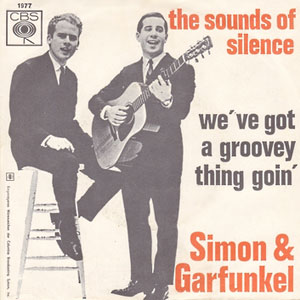
"The Sound of Silence"


"The Sound of Silence" by Simon and Garfunkel is a classic song essentially tied to an era of young, counter-cultural Americans but full of such artistic depth and aesthetic beauty that it is timeless in its appeal to music fans of all ages. This is the song that propelled the folk duo, Simon and Garfunkel, to stardom in 1965.


Structure


Most songwriters think of standard song-structure as verse, chorus, verse, chorus, bridge, chorus or some variation on that. "The Sound of Silence," however, goes a little something like this: verse, verse, verse, verse, verse. That's right! Five verses. This kind of form is known as strophic. The melody is basically the same for each of the five verses. It's like a hymn where the harmony and melody stay the same but the lyrics change for each repetition.


Lyrics


The song tells a story. There is a beginning, middle, and end. Without a strong, interesting story to take us through the repetitive musical form, the song might be very boring. But, the strophic musical form can lend itself very well to story telling because our attention is not being pulled away from the lyrics by new musical ideas. Whenever a new musical idea comes in, it may take focus off of the lyrics. In this song the music is fit for the lyrics. The music serves the lyrics, and the story draws us into the song. Also, important to remember is that each verse ends with what might be thought of as the "hook." The words, "the sound(s) of silence," conclude each verse, and those words fit logically into the idea of each verse. That's not easy to do!


Here's my simplified summary of the story-concept structure:

V1 Introduction of the vision and greeting to the darkness to which the singer is singing.

V2 Description of the vision. Narrow streets, cold and damp, a flash of neon light.

V3 Finally, the important thing, the conflict, the disturbing image of people living a half existence oppressed in silence.

V4 Next, the poet or singer speaks out against the indifference to wake people from their apathy and unthinking worship

V5 The people continue to worship their idol, and then the warning comes from something Beyond the multitude and the poet. Its words are a biblical allusion to the "writing on the wall" and the "still small voice" of the Lord.


More Simplified Still:

V1 Intro

V2 Beginning of explanation, (setting)

V3 The conflict is shown

V4 The hero tries to help in vain.

V5 A warning from Beyond (no resolution for the people in the vision; only a lesson for the audience)


So the easy part of writing a song like this is what we have just looked at: the clever structure. The hard part is having the compelling story concept. And, with that, I cannot help. We all must keep reading, dreaming, and living if we want to find inspiration.

Tuesday, July 6, 2010

"Break On Through" by The Doors

Let's focus on the rhythm of this song. While most songs have different sections (verse, chorus, bridge, etc.) that are mainly identified by different melodies, harmonies, and lyrics, "Break On Through" by The Doors is sectioned most notably by rhythm and lyrics. There are three main rhythmic sections: the song begins with the hushed, frantic pattern on the ride cymbal and the rim of the snare; the second is the two bars of hits that happen before every chorus with the lyrics such as "Can you still recall the time we cried?"; and finally, the third rhythmic section is the chorus' drum pattern with the snare on beats two and four and the slightly open hi-hat busting out the eighth notes. Very rarely, it seems to me these days in the midst of so much hip hop and indie music that makes use of electronic beats, does a radio hit have so much variation in drum patterns.

So, let's break down the structure of the song:


1) ride rhythm (verse 1)

2) hits

3) full out (chorus)


4) back to ride rhythm (verse 2)

5) hits again

6) full out (chorus) again

7) back to ride rhythm (organ solo)

-towards the end of the solo, Jim starts singing again, "Everybody loves my baby..." and the ride rhythm opens up a bit, but the rhythm is still basically the same.


8) ride rhythm (verse 3)

9) hits

10) full out (chorus)

11) chorus pattern is maintained and continues to grow with Jim's howling and further lyrics.

-the lyrics that he sings here are based on the rhythmic pattern of the two bars of hits, and this anticipates the last set of hits to come before the song comes to a close.

12) hits ("long and straight, deep and wide")

13) full out (chorus)

-and this builds to the song's zenith of energy until it comes to a dramatic, dead stop.


The most climactic moment of the song happens when the two bars of hits makes its last appearance with the lyrics "Long and straight, deep and wide" (list item number 12 above). When it appears at the end of the song, it is preceded by the full out drum beat of the chorus and succeeded by the same. Usually it comes as a transition between the more subdued verse pattern and the full out chorus pattern, but it's used differently here. We get something familiar (the two bars of hits) in a new context (in the midst of the full out drum beat).

Try focusing on rhythm to make a sense of direction in a song instead of focusing on harmonic progressions or melody alone. Another consideration about "Break On Through" and The Doors in general is that their music is very blues based, so harmonic progressions aren't so much a focus for them anyway at least when compared to other songwriters such as Billy Joel, The Beatles, or American Songbook composers such as Harold Arlen, Ira Gershwin, and the like.

And here's a picture I took of Jim Morrison's grave when I had the privilege of visiting Paris a couple months ago.